







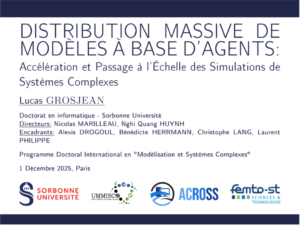
On December 1st, 2025, Lucas Grosjean successfully defended his PhD thesis entitled “Massive Distribution of Agent-Based Models: Acceleration and Scaling of Complex System Simulations” at Sorbonne University, Pierre and Marie Curie Campus. The defense marked an important milestone in research on high-performance simulation of complex systems.
The PhD was conducted under the supervision of Dr. Nicolas Marilleau (Research Director, Sorbonne University) and Dr. Nghi Quang Huynh (Research Director, Can Tho University), with co-supervision from Dr. Alexis Drogoul (Research Director, UMMISCO, IRD), Dr. Bénédicte Herrmann, Dr. Christophe Lang, and Dr. Laurent Philippe (University of Franche-Comté). The defense committee also included Dr. Damien Olivier (IUT Le Havre) and Dr. Frédéric Amblard (University of Toulouse Capitole) as reviewers, as well as Dr. Dorra Louati (Mediterranean Institute of Technology) and Dr. Stéphane Galland (University of Toulouse Capitole) as examiners.
About the PhD Thesis “Massive Distribution of Agent-Based Models: Acceleration and Scaling of Complex System Simulations”
This thesis explores the massive distribution of agent-based models, an essential approach for simulating large-scale complex systems. With the increasing complexity of models and the need to address ever larger and more challenging problems, reducing simulation time has become a major issue. The thesis proposes a new methodology based on a distribution model that efficiently allocates agents across high-performance computing (HPC) infrastructures, while ensuring the consistency and performance of simulations. This approach aims to make the distribution of agent-based models easier for modelers by making HPC methods accessible and simple to implement. Several architectures and tools are compared, and concrete case studies, such as the MAELIA and CAMMISOL models, illustrate the applicability and benefits obtained, including significant reductions in simulation time and the ability to scale up to larger simulation sizes.
A key contribution of the work is the introduction of a Distribution Model by improving the simulation time of two representative case study Agent-Based Models (ABMs), CAMMISOL and MAELIA. This Distribution Model functions as a Meta-ABM, a second ABM designed to manage the computational distribution of the primary model, which allows us to enable parallel execution without changing the original ABM code. This architectural approach yielded a 27x time faster run-time for CAMMISOL and an up to 11x time faster run-time for MAELIA.
This successful defense highlights a significant contribution to the field of agent-based modeling and high-performance simulation, with promising implications for future research on large-scale complex systems.
–
In 2022, Lucas Grosjean began a six-month Master’s internship at the ACROSS Laboratory, a critical experience that helped shape his PhD research topic and supported his successful application to the international PhD program at Sorbonne Université. Following this initial stay, he returned to ACROSS for six-month research periods each year throughout his doctorate. This engagement allowed him to build a strong professional network and collaborate closely with researchers specializing in agent-based modeling. Notably, his work benefited from direct interaction with the developers of the GAMA platform. In addition to his research activities, Lucas actively contributed to the scientific life of the lab by participating in the annual GAMA Coding Camps to develop new features and by presenting his work at GAMA Days.
Read more about Lucas Grosjean’s research at: https://scholar.google.com/citations?user=B3PFQT0AAAAJ&hl=en


