






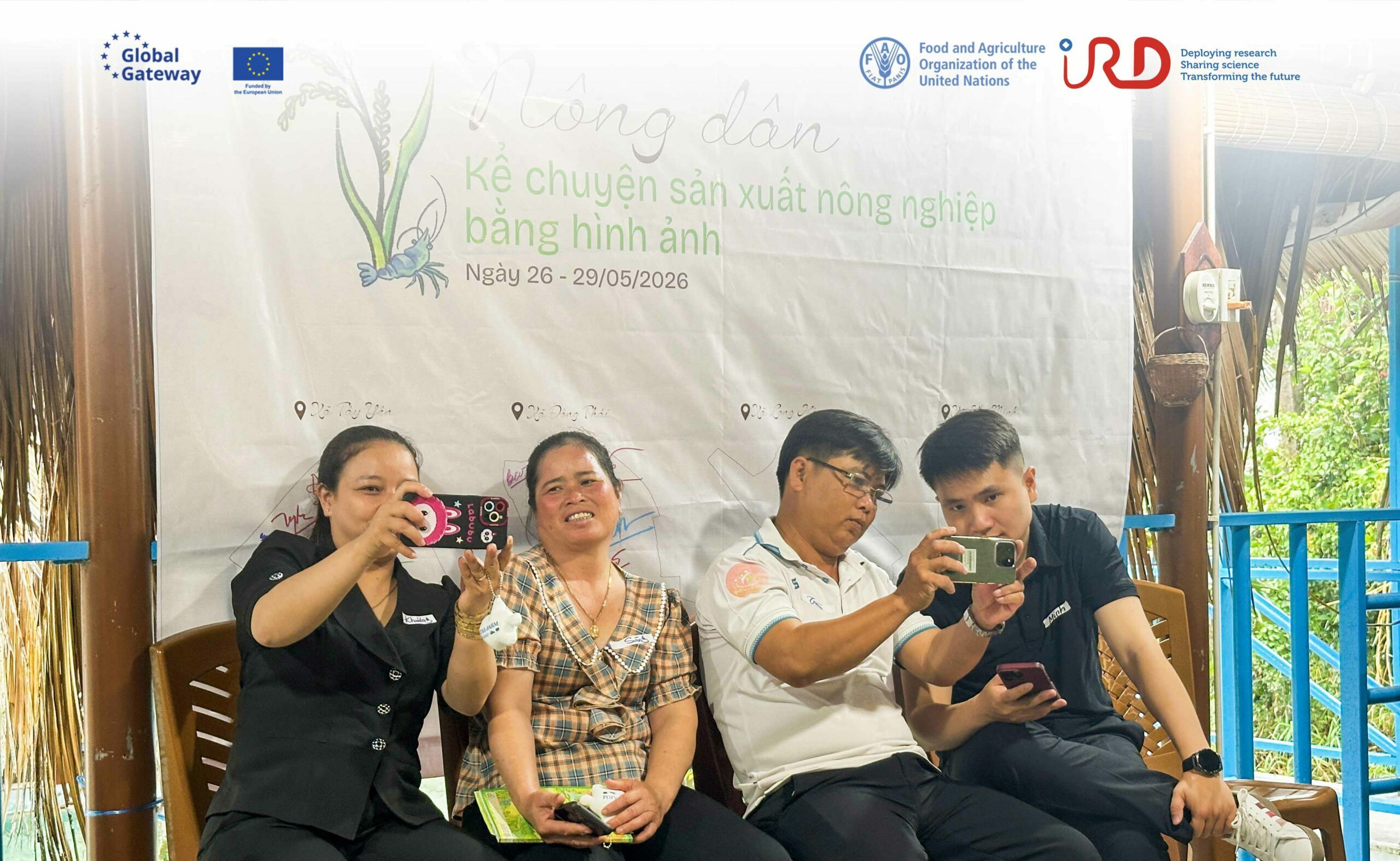
From 26-29 May 2026, within the framework of the STAR-FARM Project, the research team from the French National Research Institute for Sustainable Development (IRD) organized two training sessions on photovoice for rice-shrimp farmers and relevant stakeholders in Tay Yen commune (An Giang province) and Hoa Minh commune (Vinh Long province). This activity is part of Activity 2.1.2. Identify and address the specific constraints of women and youth in adopting innovations.
Photovoice is a participatory, action-oriented research method that combines photography and storytelling, enabling participants to document and share their own experiences through images and personal narratives. Through this activity, participants will use their smartphones to capture photographs and develop stories about their agricultural production practices, the rice shrimp value chain and the potentials towards smart agro-ecological transformation of agri-food farming systems.
The photovoice component is expected to achieve the following objectives:
- Strengthening Voice and Participation: Creating opportunities for farmers, especially women, youth and young farmers, and Khmer population, to share their perspectives, experiences, and personal stories related to rice-shrimp farming, thereby reflecting local practices, people’s perspectives on the potentials and risks about farming practices that are ecological, organic, environment-friendly, sustainable, and adaptive to climate change.
- Building Communication and Documentation skills: Equipping farmers with basic knowledge and skills in photography and visual storytelling to document and communicate their experiences of ecological agricultural transition in their local communities.
- Promoting Co-learning: Encouraging dialogue and knowledge exchange among community members regarding safe, organic, and environmentally friendly rice-shrimp farming practices.
Bringing Farmers Together Through Learning
The first training session was held in An Giang on 27 May 2026 and welcomed 23 participants, including members of Bao Tram Cooperative in Tay Yen commune, members of Nam Quy Cooperative in Dong Thai commune, and other local rice-shrimp farmers outside cooperative networks.
The second session took place in Long Hoa-Hoa Minh islet, Vinh Long on 29 May 2026, bringing together 15 participants from Hoa Minh Fragrant Rice and Clean Shrimp Farmer Group, Minh Long Farmer Group in Long Hoa commune, and Con Chim Community Agricultural and Tourism Cooperative.
Participants included farmers, local officials, agricultural workers, and representatives from community-based tourism initiatives. Women represented at least 50 percent of participants in both sessions, while Khmer farmers and young participants were also actively engaged throughout the training.
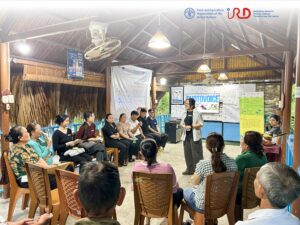
Ms. Phuong Linh (Team leader of Activity 2.1.2) introducing the STAR-FARM Project and Activity 2.1.2 during the training session in Hoa Minh
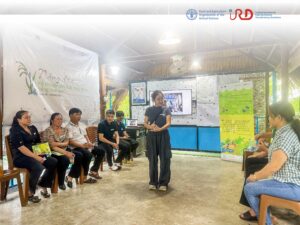
Ms. Ly Ly and Ms. Thuy Duong introducing the photovoice activity and obtaining participants’ consent for photography and documentation in Tay Yen and Hoa Minh, respectively.
After a fun ice-breaking minigame, participants joined group discussions to identify and reflect on potential, organic-oriented and other agroecological rice-shrimp farming practices currently used in their areas.
Farmers shared a range of environmentally friendly techniques, including creating natural food sources for shrimp using snails and clams, applying lime and probiotics to improve pond water quality, reducing soil acidity in rice fields (rửa phèn), and planting flowers along riverbanks to repel insects while enhancing the local landscape. Organic farming for export markets was widely discussed and highlighted as a promising practice that offers both higher returns and a safer environment, particularly for farmers themselves.
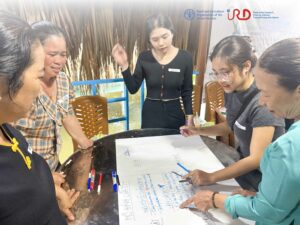
Farmers actively participating in group discussions with the facilitation from the research team.
Learning the Art of Visual Storytelling
The training sessions were facilitated by two experienced photovoice practitioners, Mr. Le Quang Minh and Mr. Hoang Le Anh from ECUE (Hanoi), who have worked extensively with diverse communities across Vietnam.
The trainers introduced participants to the principles of photovoice, ethical considerations in community photography, and practical techniques for taking captivating photographs. Participants then practiced using their own smartphones to capture images and received feedback and guidance from the trainers.
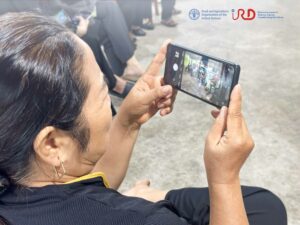
Participants practicing taking photos with their smartphones.
The sessions were highly interactive and combined hands-on learning with opportunities for discussion and reflection. Participants actively engaged in the activities, group discussions, and photography exercises, creating a lively learning environment throughout the training. Many expressed enthusiasm about the opportunity to document their own experiences through photographs and share stories about their agricultural practices. Beyond photography skills, participants began exploring how images can be used to communicate personal experiences, local knowledge, and agricultural products and innovations.
In the coming weeks, participants will document their own farming activities and experiences through photographs taken with their smartphones. The research team will work alongside participants to jointly select photos and develop stories that reflect their agricultural journeys and perspectives.
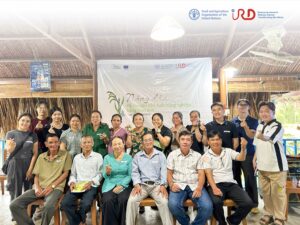
Rice-shrimp farmers, local officials, photovoice trainers and members of the IRD research team at the conclusion of the training sessions.
Looking ahead
The research team hopes that this activity will contribute not only to a deeper understanding of farmers’ experiences, but also bring in motivation for the farmers and value chain actors to express their agency, boost exchanges, awareness and continuous discussion about farming practices that are ecological, organic, environment-friendly, sustainable, and adaptive to climate change. Furthermore, the activity will potentially contribute to the continued development of participatory research approaches in agricultural development projects.
Building on the photovoice experience, the team also plans to explore video co-production methods in the coming months as a way to further strengthen farmer participation, amplify local voices, and diversify project learning and documentation activities.


