






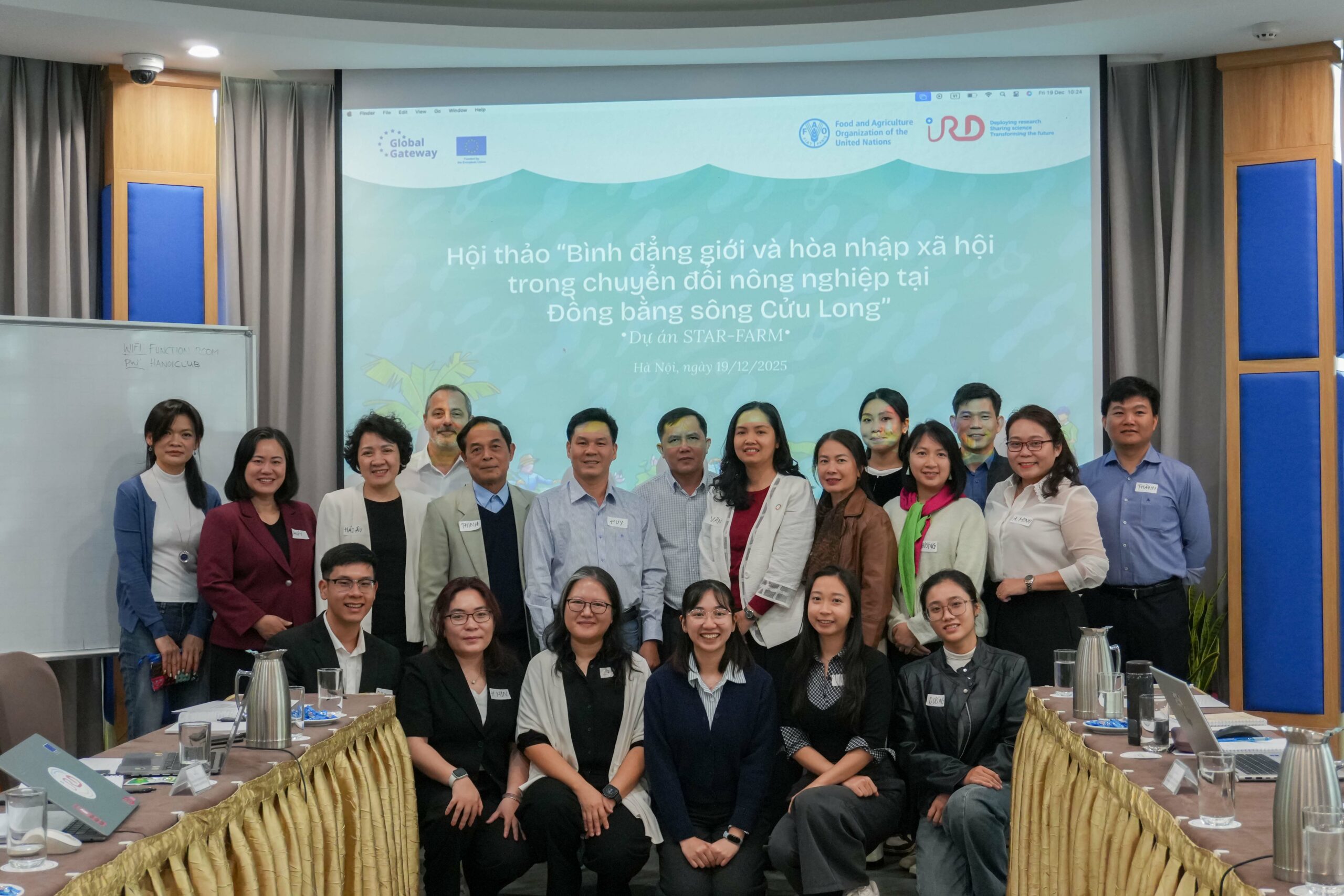
On Friday, 19 December 2025, within the scope of the STAR-FARM Project, the French National Research Institute for Sustainable Development (IRD) in Hanoi organized the workshop “Gender Equality and Social Inclusion in Agricultural Transformation in the Vietnamese Mekong Delta (VMD)” in Ha Noi. The event brought together researchers and practitioners from non-governmental organizations working in the fields of sustainable development, agriculture development, and social inclusion.
Workshop objectives
The workshop aimed to create a platform for dialogue on social inclusion, gender equality, and community participation in the context of agricultural transformation in the VMD. Discussions focused on current approaches and key social dimensions addressed in research and development projects in the region.
In addition, the workshop sought to obtain expert feedback on the preliminary findings of Activity 2.1.2 of the STAR-FARM Project, particularly:
- the review of Gender Equality and Social Inclusion (GESI) strategies adopted by development projects in the VMD, and
- the initial approach to the development of social justice indicators and/or mechanisms to better capture the social impacts of agricultural transformation and to support innovation processes.
Participants of the workshop included researchers and practitioners from non-governmental organizations working in the fields of sustainable development, sustainable agriculture, and social inclusion.
Dr. Alexis Drogoul, Team Leader from IRD in the STAR-FARM Project, delivered the opening remarks.
Dr. Huynh Thi Phuong Linh, Leader of Activity 2.1.2, presented an overview of the activity and its key objectives. The activity aims to better understand the potential and constraints faced by different groups in adopting innovative agricultural practices, and to ensure the meaningful participation of youth, women, and other vulnerable groups in the adoption and scaling of innovations for climate-smart agricultural transformation.
Key discussions
The morning session featured four presentations that set the scene for understanding agricultural transformation in the VMD. Speakers addressed a range of interconnected issues, including the socio-economic context of agricultural transformation in the region, farmers’ positioning in agricultural value chains, rural out-migration and its social implications, and women’s participation in agricultural production. These presentations sparked lively and in-depth discussions, highlighting the complexity of social inclusion challenges within ongoing agricultural dynamics in the region.
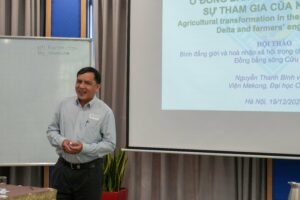
Assoc. Prof. Dr. Nguyen Thanh Binh opened the presentation session with “Agricultural transformation in the VMD and Farmers’ engagement”. He highlighted the 5Ps drivers of transformation in the region, namely Price, Producer, Policy, Place and Project.
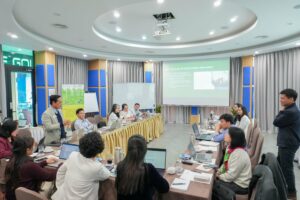
Mr. Nguyen Hung Cuong, Private sector engagement specialist from Oxfam in Vietnam, discussed “Farmers in value chains: Opportunities and risks for different farmers’ groups”, followed by interactive exchanges with participants. It was emphasized that farmers play a crucial role in the agricultural value chain; however, their bargaining power and position are not on par with those of enterprises or traders.
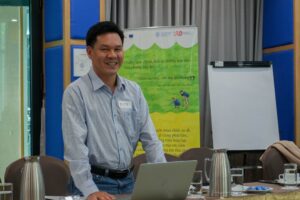
Assoc. Prof. Dr. Huynh Truong Huy delivered a presentation on “Out-migration from rural areas and its implications”. While income is an important factor in out-migration decisions, it is not the key driver. The presentation and subsequent discussion also underscored significant differences in out-migration patterns across gender and age groups.
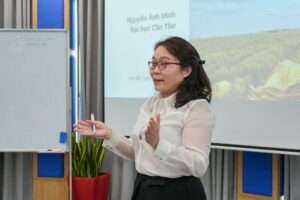
Dr. Nguyen Anh Minh presented “Women’s participation in agricultural production in the VMD”. Her findings highlighted gender differences in the division of labor, where men tend to engage more intensively in farming activities, while women are primarily involved in unpaid care work and less labor-demanding agricultural tasks.
During the afternoon session, attention shifted to different approaches to gender mainstreaming and social inclusion in agricultural research and development. Particularly, the team responsible for Activity 2.1.2 of the STAR-FARM Project presented their preliminary findings from the review of GESI strategies implemented by development projects in the VMD, as well as their proposed approach to developing social justice indicators. Participants provided constructive and thoughtful feedback, offering valuable insights that will help refine the methodology and guide the next steps of the activity.
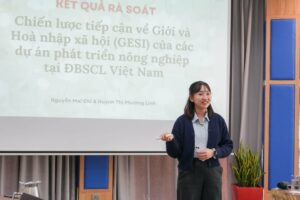
Ms. Nguyen Mai Chi from IRD presented findings from the review of gender mainstreaming strategies in development projects. The team adapted the Gender Integration Strategy Typology (Danielsen et al., 2018) and analyzed projects based on their impacts across three levels: Reach, Benefit, and Empower.
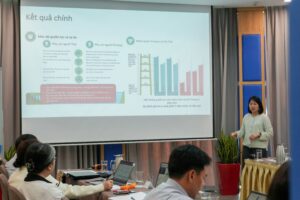
Dr. Nguyen Mai Phuong delivered her presentation on “Mainstreaming gender and local knowledge in participatory agricultural research”, with important considerations for engaging different farmers’ groups, especially those that are underrepresented like women from ethnic minorities.
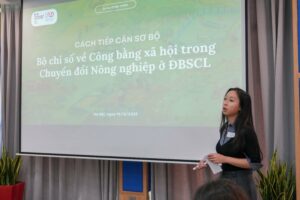
Ms. Nguyen Ly Ly presented the team’s preliminary approach to the development of the social justice indicators in agricultural transformation. The presentation was followed by a lively discussion on how to practically address gender equality and social inclusion within the scope of the project.
Looking ahead
The workshop underscored the importance of integrating gender equality and social inclusion considerations into agricultural transformation processes. The rich exchanges and expert feedback received during the event will contribute significantly to the continued development of Activity 2.1.2 of the STAR-FARM Project and to broader discussions on inclusive and sustainable agricultural development in the VMD.


